



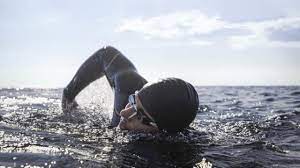
Crawl swimming style is a way in which the arms make smooth and powerful strokes while moving, and the legs work like scissors. With the forelimbs, the swimmer pushes the water back and returns forward, and with the hind limbs it makes wave-like movements. The athlete’s face is hidden under water most of the time, it is shown on the surface only to take a breath. You can swim in this technique both on the chest and on the back with lifeguard recertification.
Crawl is called not only the fastest, but also the most natural way of swimming. All athletes who set world records in the discipline used this particular method. And today, technique is also associated with freestyle.
Translated from English, the name of the style means “to crawl”. Its development belongs to Charles Daniels. He created methodological recommendations for teaching crawl at the beginning of the twentieth century. The technique is distinguished by the type of footwork: six-, four- or two-strike. However, the main driving force in crawl swimming is the hands.To learn to swim in crawl style, it is more important to work out not only the physical form, but to study the technique in detail. Its violation leads to the loss of energy consumption and, accordingly, speed. It is best to understand the nuances of the movement of arms and legs, breathing together with the instructor, but nothing will prevent you from learning the rules on your own.
Style Benefits
The high-speed swimming style differs from others in that the body is in continuous motion. The muscles of the arms, shoulders and back receive the greatest load. Despite the complexity of the technique, crawl is ideal for those who want to become a professional swimmer. And learn how to swim as fast as possible.
Swimming crawl can be compared to endurance training. This type of load perfectly develops strength, trains breathing and helps burn a lot of calories. Due to the tension of the abdominal muscles during movements, the technique allows you to remove fat from the waist and abdomen.
Like other styles of swimming, crawl has a positive effect on the functioning of the cardiovascular system. Regular exercise strengthens the immune system, improves blood circulation and gently massages the internal organs. Active swimming gently loads the ligaments and joints, so it can be practiced as a physiotherapy exercise.
Crawl is also attractive to many in that when swimming in this way, the load on the spine is minimized. But nearby muscles are strengthened intensively. Therefore, the technique is recommended for intervertebral hernias, problems with posture.
How to learn to swim front crawl
Swimming front crawl allows you to develop maximum speed than moving on your back. During movement, the main load is received by the muscles of the arms, chest and shoulders. To learn how to swim in this technique, you must use goggles and a cap, optionally a mask with a snorkel. With it, it will be easier for a beginner to concentrate on movements, control his body.
The first thing to do in learning the front crawl is to learn how to balance in the water. To do this, lie down on the water and try to relax. The body itself will keep the person on the surface. You should also try holding your breath while remaining in the water. The exercises “Asterisk”, “Float” will help to learn to control the body and maintain balance.
“Float” is simple – you need to go into the water to chest level, take a breath, and then sit down and plunge, clasping your knees with your hands. To stay on the surface, it is worth grouping, pressing your chin to your chest. Maintain this position for as long as possible. From the “Float” exercise, you can move on to learning to glide on the water.
Having taken the same position as in the “Float”, you should push off from the bottom or side with your feet, and then take a prone position. At the same time, the face should be lowered into the water, the arms should be straightened and connected. The head should be between them. In this position, you need to slide along the surface, alternately pushing off the bottom with your feet.
Breath
Proper breathing is the key to moving quickly and saving energy. Adult swimmers are advised to learn to breathe on the second stroke, and children – on every third. During breathing, the muscles are saturated with oxygen, which is needed to perform active actions. It should be comfortable, as when walking, but with the following features:
—The breath is taken through the mouth, it must be sharp due to the limited stroke.
—Exhale – simultaneously through the mouth and nose smoothly into the water, but beginners should do it only with the mouth to avoid getting liquid into the nose.
The exhalation should be longer than the inhalation, about 2-3 times longer. It must be started at the moment of lowering the face into the water, but a slight delay is also allowed. The breath itself is taken during the stroke, turning the face towards the hand moving above the water.

