
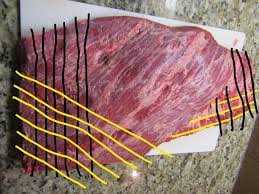
You might think that cutting cuts of meat is a piece of cake for each of us. That certainly could be the case, at least if we remember the reason behind cutting meat against the grain. However, we have included it to make you even more aware of how to cut a piece of steak. After that, the way you cut will speak volumes about the magic of all your culinary endeavors. And when we say magic, we visualize the tenderness of the steak and its juicy and delicious texture.
Cutting against the current is mandatory, but not enough
Well… let’s not forget that the juiciness and tenderness of your cut of meat does not only depend on how you cut the steak. Cutting against the grain is absolutely necessary, but not sufficient, as there are other aspects that contribute to the tenderness of the meat. And here we could name a few:
The age of the meat is quite important, so people often go for a younger animal whose muscles have not been used for a long time.
The part of the animal’s body from which the cut of meat was taken is another detail that affects the tenderness of your steak. It all comes down to which part of the body the meat uses the least or the most. The more a body part is used, the more collagen it contains and the less fat it contains. For example, the primary leg tends to be harder due to the muscles working in that area. The ribs and loin have supporting muscles and more fat that keep the meat moist and therefore make these parts really tender.
The way Steak Restaurant Dubai cooks the piece of meat affects the juiciness of the meat, so the more liquid the meat loses, the tougher it becomes. Therefore, cooking methods like braising and braising are great for tenderizing collagen-rich cuts.
We’re going to describe the cut of beef backward, starting with the “why” to answer more to your “how.” The reason for this is given by the fact that everyone needs to understand why we should cut a steak a certain way without getting confused by some grill marks or some notches on the meat packaging. This should be more than enough to answer your how to cut steak.
Understanding why cut against the grain
The grain of the meat indicates the direction of the muscle fibers. Whether we’re talking about working or supporting muscles, spotting the pimple is a must. You can see the direction of the lines in both cooked and raw meat, they look like long stripes.
You will find different cuts of meat and the grain will not be the same depending on the slaughter method. Therefore, following and understanding fiber optic lines is essential. Whether it’s a Porterhouse, a pendant, a brisket, or anything else, continuing to cut against the grain still holds true. It is not about connecting a piece of meat with a certain way of cutting, although there are pieces of meat that always have the same direction. It’s just a matter of examining your fillet before you cut it because if you take more hangers, for example, you may notice a different grain with each hanger.
How to cut steak correctly
Once you have seen the direction of the grains, you are ready to start cutting against or perpendicular to that direction.
Of course, remember that you should always start cutting with a well-done steak (this preserves the juiciness of the steak) because it is already ready to cut and you can see very clearly the lines of the grain going through the meat and a kind of diagonal line. Shape.
Try to address or understand how the grain passes through the piece of meat you have. There is no art here, but what is just as important is cutting the steak perpendicular to the lines of the grain, or cutting against the grain as others would say. This way you have short fibers that melt in your mouth super soft and tender instead of long fibers that make you forget about the great taste and chew that piece longer.
That’s all about cutting the meat correctly. Please let us know if there was a time when this logic didn’t work so well for you and describe it briefly, because we’re curious about it.