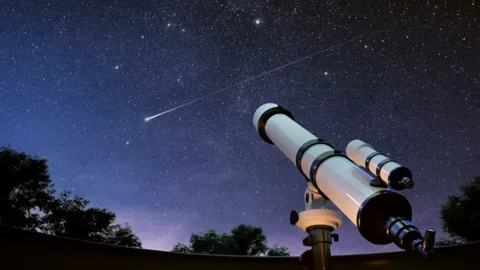
Are you fascinated by the night sky and want to use your garden to learn more about the universe? A great astronomy experience may be achieved by selecting the appropriate telescope. India’s varied terrain provides great viewing opportunities everywhere, from the dark rural areas far from city lights to the brilliant sky of Ladakh. In order to acquire the best telescope for your astronomical goals, this article will assist you in navigating the somewhat perplexing world of telescopes.
1.Understand the Different Telescope Types
The first step into your telescope adventure is knowing the three main types of telescopes, that is; refractors, reflectors and compound telescopes. Refractors that use lenses are excellent when it comes to clear pictures of the moon and planets. Reflectors use mirrors instead of lenses hence they are cheaper as well as could collect light from deep sky objects such as galaxies and nebulae. Both of the methods are used in compound (or catadioptric) telescopes which are flexible and very small but are always more expensive. It depends on your primary interest – lunar observation, planetary detail or deep-sky wonders – which option will be the best for you.
2.Consider Aperture Size as Your Priority
The aperture size of the telescope would be your top consideration when purchasing a telescope. How much light enters the telescope is dependent upon aperture-that is, the diameter of the primary optical system. By the higher apertures, more light is taken up, revealing smaller details and less important things. Although the 150mm reflector shows several galaxies and nebulae, the 80mm reflector is suitable for viewing the moon & planets. Bear in mind that larger apertures generally provide larger views, but generally tend to involve heavy appendages as well as more expenses. Strike a balance between cost, mobility, and optical power.
3.Focus on Mount Stability, Not Just Magnification
Many first-time purchasers ignore mount quality in favor of focusing on promises about magnification. The foundation of a telescope determines its quality. It is challenging to observe the stars because it has blurred pictures if the mount is not balanced. Altazimuth mounts are easier to work with and in most cases cheaper than the equatorial mounts that are excellent for astrophotography and track the movement of objects across the sky. Tap the tube carefully while testing telescopes; the vibrations should subside shortly. Purchase a telescope that will allow for years of consistent gazing with a sturdy, reliable mount.
4.Evaluate Portability and Storage Requirements
Sincerely consider where in addition to how frequently you plan to use your telescope before making a purchase. If an instrument is too difficult to set up on a regular basis, it loses its usefulness. Portability becomes essential if you live in an apartment with little storage or must travel to places with little light. Although they might be heavy, Dobsonian reflectors have great performance-to-price ratios. For the residents of the city who have limited storage, compact refractors or Maksutov-Cassegrains may be more appropriate. Bear in mind that the best telescope does not always come in the biggest or most powerful size. it is the one you will actually use.
5.Check for Quality Eyepieces and Accessories
Optical tube is only one of the elements of the telescope system. The eyepieces of high-quality will play an important role in your viewing experience and they must be taken into account when making your budget. Common entry-level telescopes come with basic eyepieces of low and medium magnifications. Another helpful add-on is a Barlow lens that in essence doubles or triples your collection of eyepieces by increasing magnification. In order to maintain night vision, take into account extras like star charts, and moon screens (which lessen lunar glare), along with a red torch. High-quality attachments increase your instrument’s use and observation capabilities.
6.Research Reliable Brands Available in India
Even though brand is not everything, famous manufacturers usually maintain quality rules and provide better customer service. With distribution networks in India offer a range of products at various price ranges. Reputed brands are generally transported by local dealers all over large cities such as Delhi, Mumbai, Bangalore, and Chennai. Online forums for astronomy may provide you with the most recent information about availability, cost, user experience with some models to help you make an informed decision based on information from real users.
7.Set a Realistic Budget with Room for Growth
The price of a telescope can range from a few thousand rupees to several lakhs. Budgetary restrictions do exist, but very low-cost telescopes sometimes offer unsatisfactory results that might put off future interest. Spend between ₹15,000 and ₹20,000 for a good entry-level instrument. High-quality binoculars (10×50 or comparable) provide an excellent introduction to the night sky at a reduced cost if money is limited. Don’t forget to account for extra costs like books, and filters, as well as eyepieces. It is frequently more cost-effective to make a thoughtful investment in a high-quality beginner telescope rather than continuously upgrading from annoying low-cost versions.
8.Try Before You Buy When Possible
Nothing can take the place of actually using a telescope before making a purchase. Attend star parties hosted by neighborhood astronomy societies, where enthusiasts are welcome to share their experiences and bring their equipment. These meetings offer priceless chances to view various telescopes and pose inquiries in a friendly setting. In order to assist you understand how various models set up and function, many astronomy stores give demos. In-depth video evaluations and unpacking demos can offer valuable insights into simplicity of assembly and operation if in-person testing is not feasible.
Conclusion
Discover the celestial treasures that are visible from India sky, such as distant galaxies, bright double stars and Saturn rings. Select your best telescope for stargazing wisely, with the main emphasis on robust mounts, and good optics, as well as practicality, and not on advertising assurances. With the right equipment, you can embark on a life-long journey through space exploration and see the unbelievable beauty of the universe right from your backyard.
Table of Contents